
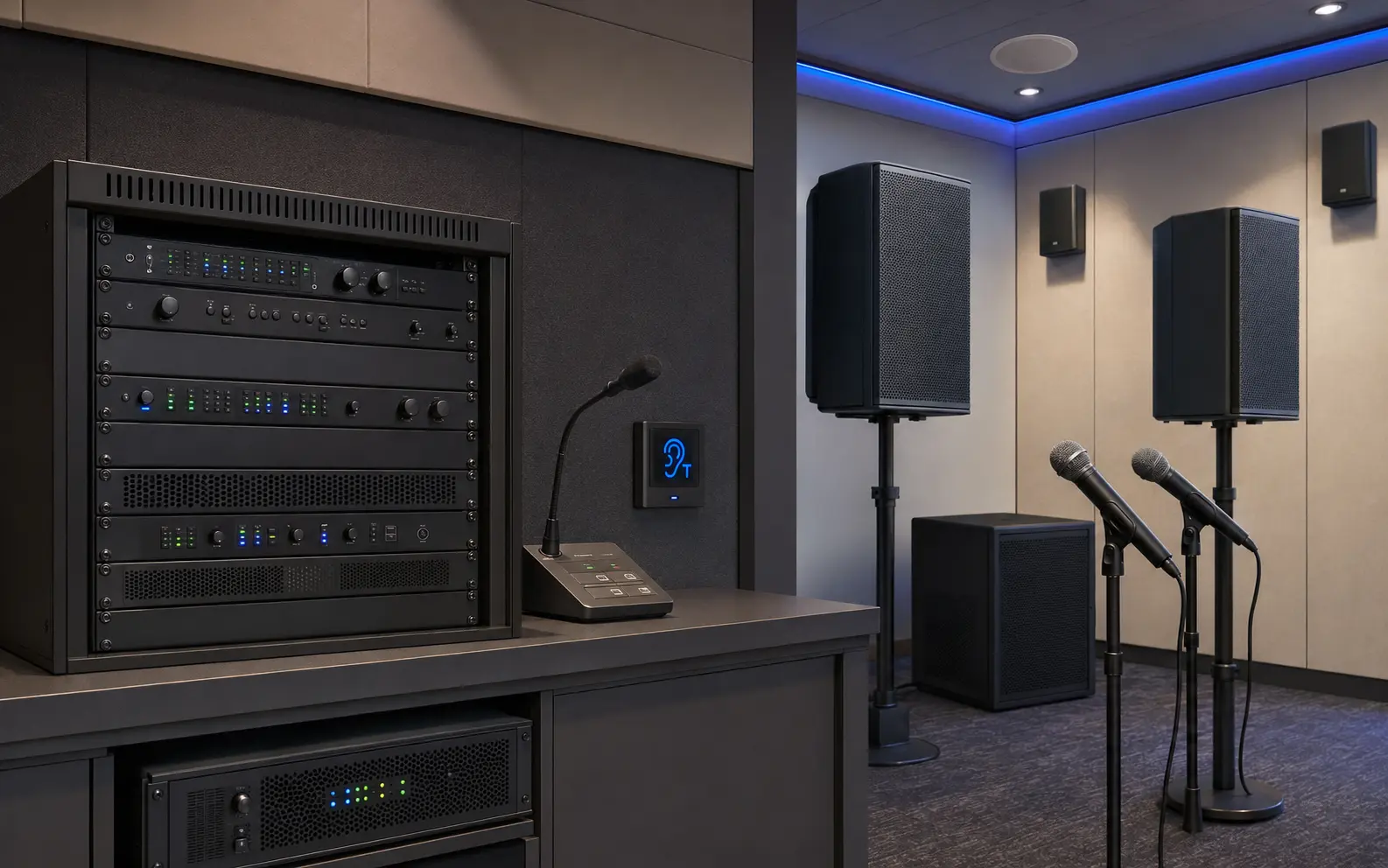
Public address, background music and emergency voice messaging can share speakers and amplifiers, but the control architecture and reliability requirements are not automatically the same. The requirement should be defined from the building's operating and emergency workflow before choosing equipment.
Three common architecture levels
| System level | Main purpose | Typical control requirement | Example PNSS reference |
|---|---|---|---|
| Conventional PA / paging | Announcements and BGM | Zone selection, paging priority, amplifiers, speakers | Application-led PA design |
| IP-based PA management | Large or distributed paging/BGM networks | Network zones, schedules, monitoring, multi-channel audio | Amperes PMX III |
| Voice alarm / EVAC | Emergency voice messages plus PA/BGM | Emergency priority, message triggering, fault awareness, backup strategy | Amperes EVM8810 family |
Routine PA: keep it simple when the requirement is simple
For ordinary paging and BGM, the design may only need microphones, source equipment, zone selection, amplification and loudspeakers. The key engineering work is coverage, intelligibility, cable topology, power and operational simplicity.
IP-based PA: useful when zones and workflows become large
Amperes PMX III is an IP-based PA management platform supporting up to 10 simultaneous audio channels and up to 1,000 zones, with scheduling and optional monitoring functions. This is useful for campuses or distributed buildings where conventional point-to-point control becomes difficult to manage.
Voice alarm: emergency priorities and reliability become part of the design
Amperes positions EVM8810 as an integrated voice-alarm controller for EVAC, paging and BGM. The current unit combines a 1000W 100V amplifier, eight zones, emergency microphone, siren/messages, fault sensing and backup-power provision, with expansion to larger zone counts.
Design checks
- Define whether the project is routine PA, operational emergency paging or a regulated voice-alarm requirement.
- Confirm fire-alarm interface responsibility and the applicable authority/consultant requirements.
- Calculate loudspeaker load, amplifier headroom and backup/standby strategy.
- Define emergency priority, zone logic and volume-override behaviour.
- Specify monitoring, network dependency and UPS/DC backup responsibilities.
- Commission speech intelligibility and operational handover—not only amplifier output.
Compliance cannot be inferred from a product name alone. The complete installed system, design, cabling, backup, interface, commissioning and authority requirements must be confirmed for the project.
Manufacturer references
Specifications and product positioning should be verified against the current manufacturer documentation before final quotation.
Continue your shortlist
Professional Audio · PA & Paging Product Library · Technology Selection Guides