Collection protection
RFID detection supports controlled exit monitoring while keeping the patron entrance visually open.

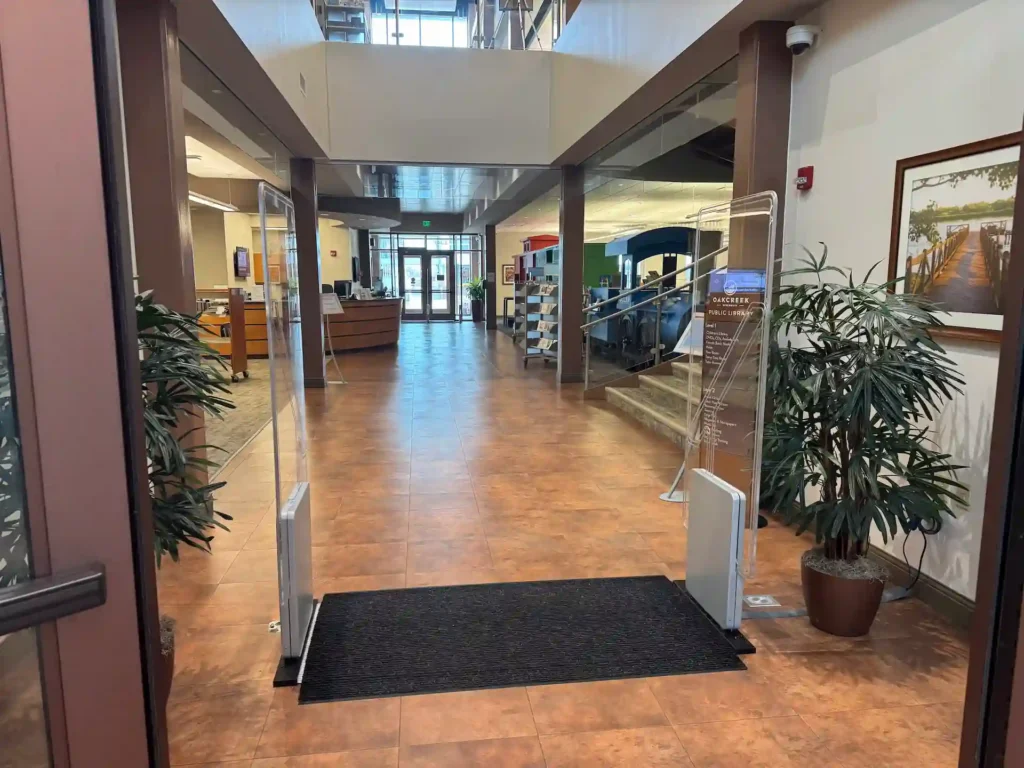
Official Bibliotheca RFID gate application image. Exact gate finish and configuration vary by project.
Bibliotheca · RFID Security & Detection
Current Bibliotheca RFID gate architecture for library collection protection, patron-flow visibility and remotely managed gate operation. Final gate count and aisle geometry must be designed around the actual entrance.
Selection guidance
RFID detection supports controlled exit monitoring while keeping the patron entrance visually open.
Bibliotheca states RFID gate ultra can support aisle spacing up to 68 in / 172.7 cm, subject to system design.
Integrated bi-directional people counting helps libraries understand entrance traffic.
staffConnect gate and libraryConnect LINK support remote configuration, status and administration in supported deployments.
Technical reference
| System type | Library RFID security / detection gate |
|---|---|
| Reference family | Bibliotheca RFID gate / RFID gate ultra |
| Aisle reference | RFID gate ultra: up to 68 in / 172.7 cm spacing per current manufacturer reference |
| People counting | Integrated bi-directional people counter |
| Management | Remote configuration and supported libraryConnect / staffConnect gate workflows |
| Planning | Gate quantity, aisle width, cabling, power and tag/security workflow must be confirmed per entrance |
Applications
Continue exploring
System dependencies
A product is only one part of the deployment. Confirm the supporting components and infrastructure before final model selection or installation.
Dependency links are planning paths, not automatic compatibility claims. Exact model/SKU, interfaces, loading, firmware/software and accessories must be verified for the final project.
Item layer
Ensure item tags/labels and security workflow align with the detection system.
Open related area →Integration
Confirm circulation/LMS integration and alarm/event workflow where applicable.
Open related area →System design
Coordinate gates, circulation, exits and patron flow as a complete system.
Open related area →Product family navigation
Return to Security & Detection, continue to the relevant solution, or open a selection guide without losing product context.
New project / active selection
Use the parent family and solution links to compare application fit. Current Malaysia availability, exact SKU, warranty terms and compatible accessories should be verified at quotation stage.
Existing installed product
Already installed? Identify the exact model and condition first, then verify lifecycle, parts/software support and the practical repair or migration path.
Open legacy & replacement support →The final equipment schedule should be based on the application, interfaces, system topology, site conditions and support requirements.